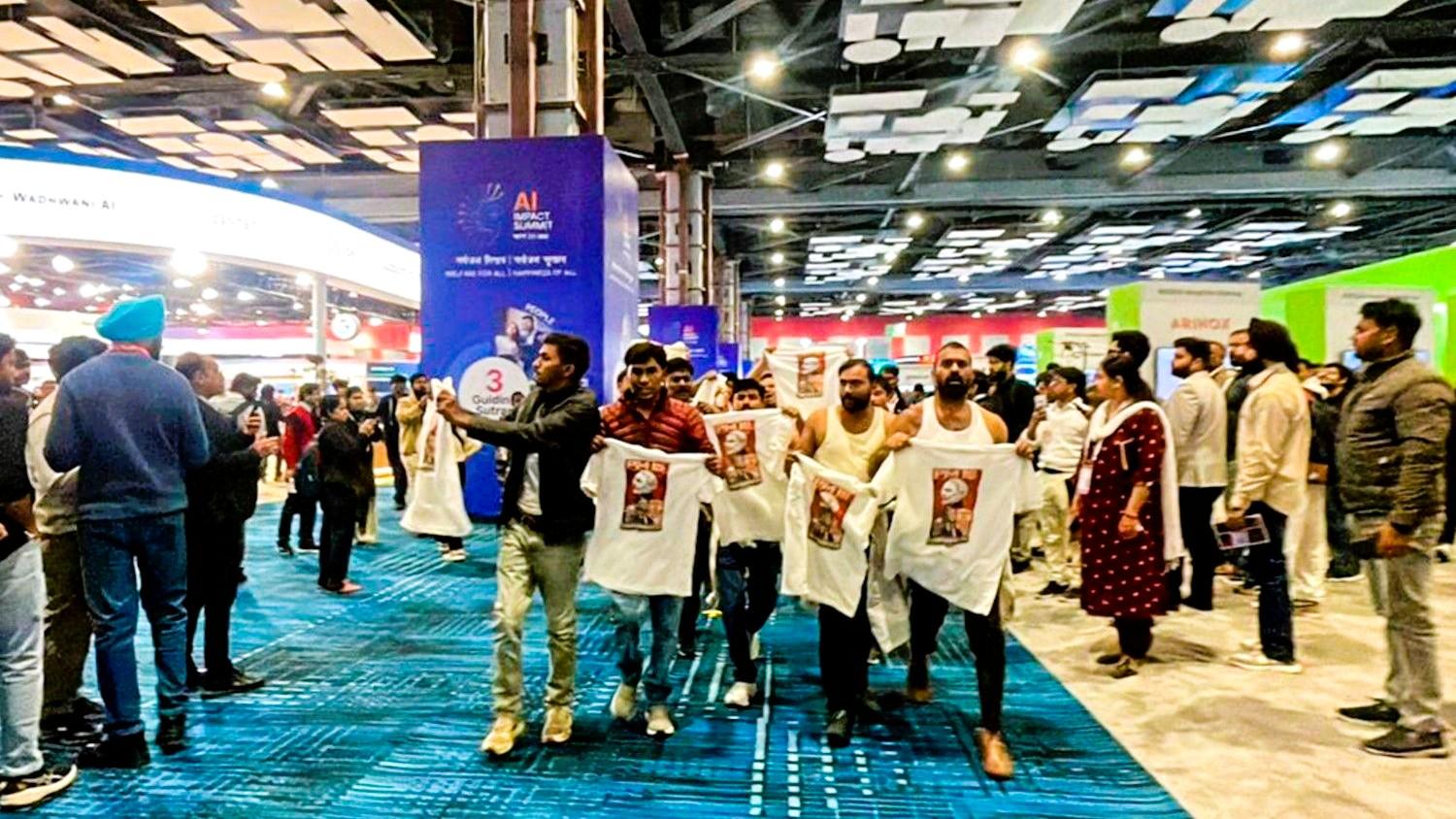
New Delhi: Delhi Police on Thursday told a court that the shirtless protest staged by members of the Indian Youth Congress (IYC) during the India AI Impact Summit was comparable to the Gen-Z protests witnessed in Nepal and was allegedly part of a conspiracy to tarnish India’s global image.
Presenting its submissions before the court, the police sought custodial interrogation of the accused, stating that further investigation was required to uncover the planning and funding behind the protest. The court subsequently granted five days of police custody for the arrested individuals.
Those taken into custody include Krishna Hari, national secretary of the IYC from Bihar; Kundan Yadav, IYC state secretary from Bihar; Ajay Kumar, IYC state president from Uttar Pradesh; and Narasimha Yadav from Telangana.
According to the police, the protest took place during the India AI Impact Summit, an international event attended by global leaders and industry representatives. Investigators alleged that the demonstrators raised anti-national slogans during the protest.
Police also claimed that the accused wore T-shirts bearing objectionable images of the Prime Minister. Authorities argued that the demonstration was deliberately staged to create negative publicity and damage India’s reputation at an international platform.

In court, police officials said the protest bore similarities to the Gen-Z protests seen in Nepal, suggesting a coordinated approach aimed at drawing attention and provoking controversy. They further contended that the act was not spontaneous but pre-planned.
Investigators told the court that custodial interrogation was necessary to determine the source of funding for the protest and to identify where the T-shirts allegedly used during the demonstration were printed. Police said they are examining whether there was any broader conspiracy behind the incident.
The prosecution maintained that the matter required detailed inquiry to establish the extent of coordination and possible involvement of other individuals or entities.

On the other hand, the defence argued that the accused were exercising their democratic right to protest. Counsel for the arrested individuals stated that they are members of a recognised political party and had engaged in a form of political expression.
The defence contended that participation in a protest does not, by itself, constitute a criminal conspiracy. They urged the court to consider the constitutional right to freedom of speech and peaceful assembly.
After hearing arguments from both sides, the court allowed five days of custodial interrogation to enable police to continue their investigation into the allegations.
The matter remains under investigation, with authorities examining the circumstances surrounding the protest, its organisation and potential financial backing. Further developments are expected as the inquiry progresses.