New Delhi: India has registered its highest-ever annual increase in non-fossil energy capacity, adding 31.25 gigawatts in FY26, Union Minister for New and Renewable Energy Pralhad Joshi announced on Saturday. He said that this milestone reflects India’s rapid acceleration toward a clean energy future and positions the country as a major contributor to global renewable expansion.
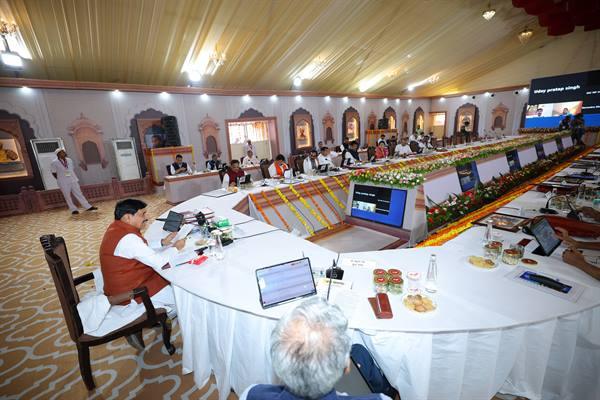
Of the total addition, 24.28 GW came from solar energy — the fastest-growing segment in India’s clean energy mix. The Minister was speaking at the Global Energy Leaders’ Summit 2025 in Puri, where he also revealed a series of new initiatives targeted at enhancing household-level solar adoption.

India Driving Global Renewable Growth
Joshi highlighted that the world took nearly 70 years to install the first terawatt of renewable energy capacity, achieving the milestone in 2022. Remarkably, the second terawatt was added in just two years — by 2024 — with India playing a key role in that rapid advancement.
India’s solar capacity alone has surged from just 2.8 GW in 2014 to nearly 130 GW today, marking an extraordinary increase of over 4,500%. Between 2022 and 2024, India contributed 46 GW of solar installations to global growth, making it the third-largest contributor worldwide.

Balancing Coal and Renewables
The Minister noted that India still relies heavily on coal, holding the world’s fifth-largest coal reserves and ranking as the second-largest coal consumer. However, he stressed that the country is steadily increasing its renewable share in the overall energy mix as part of a phased and stable energy transition.
He emphasized that global industrial competitiveness is increasingly influenced by clean energy adoption, making India’s transition not only environmentally important but strategically necessary.

Major Boost for Rooftop Solar in Odisha
A key announcement during the summit was the approval of a consumer-owned Utility-Led Aggregation (ULA) model under the Pradhan Mantri Surya Ghar initiative. Under this programme, 1.5 lakh rooftop solar units of 1 kW each will be installed across Odisha.
Joshi said the initiative is expected to directly benefit 7 to 8 lakh people, primarily from lower-income households, reducing electricity costs and improving energy access.
Odisha already shows strong progress in the renewable sector, with more than 3.1 GW of installed green capacity — representing over 34% of the state’s total power generation capabilities. Under the rooftop solar scheme alone, 1.6 lakh consumers in the state have applied for installations, over 23,000 systems are operational, and 19,200 families have collectively received more than ₹147 crore in subsidies directly into their bank accounts.
Reforms and Policy Support Driving Growth
Joshi credited India’s clean energy momentum to policy reforms, improved ease of doing business, robust infrastructure, and high investor confidence encouraged by the Central government. He also acknowledged strong Centre–State coordination as a catalyst for large-scale renewable penetration.
Expressing confidence in Odisha’s leadership, he said the state is poised for major clean energy progress in the coming years under Chief Minister Mohan Charan Majhi, Deputy Chief Minister Kanak Vardhan Singh Deo, and the people working toward a greener future.